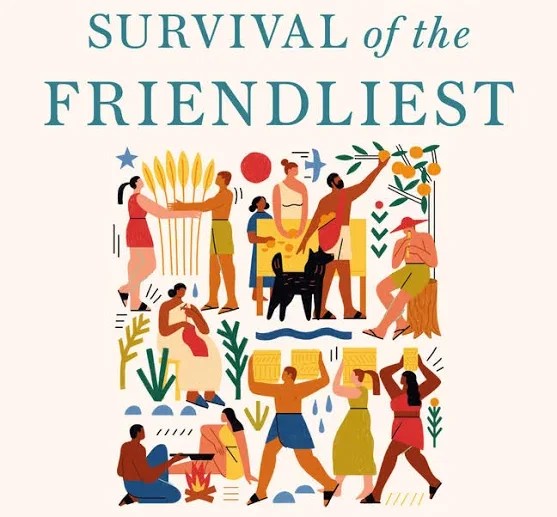
Central Thesis
The book challenges the conventional interpretation of “survival of the fittest.” Human evolutionary success did not come primarily from being stronger, more aggressive, or more ruthless than other species.
Instead, one of our greatest evolutionary advantages was friendliness: our exceptional capacity for social tolerance, cooperation, communication, and understanding other minds.
The central evolutionary chain can be summarized as:
friendliness / social tolerance
→ cooperative communication
→ larger and better-coordinated groups
→ sharing knowledge and innovations
→ more sophisticated culture and technology
→ human evolutionary success
But this same adaptation contains a paradox:
friendliness toward “us” can intensify hostility toward “them.”
The mechanisms that allow humans to form extraordinarily strong social bonds can also facilitate prejudice, dehumanization, and cruelty toward perceived outsiders.
Introduction — Friendliness as a Cognitive Superpower
The Jigsaw Classroom
During school desegregation in Austin in 1971, minority children such as Carlos entered classrooms where they could be mocked and marginalized. The conventional classroom structure could worsen the problem because students competed for the teacher’s approval; one student’s success could feel like another student’s loss.
The jigsaw method changed the social structure of learning.
Each student learned one part of a topic, and the students then had to combine their pieces to understand the whole. Success therefore required interdependence and cooperation rather than competition.
The important insight is that reducing hostility does not necessarily begin by persuading people to feel differently. Changing the structure of interaction can create cooperation, which in turn changes relationships.
Central idea
Friendliness, cooperation, and kindness should therefore be understood not simply as moral virtues but as cognitive and evolutionary capacities.
Humans survived and flourished partly because we became exceptionally good at working with other humans.
Continue reading “Survival of the Friendliest — Reading Notes”