 By
By 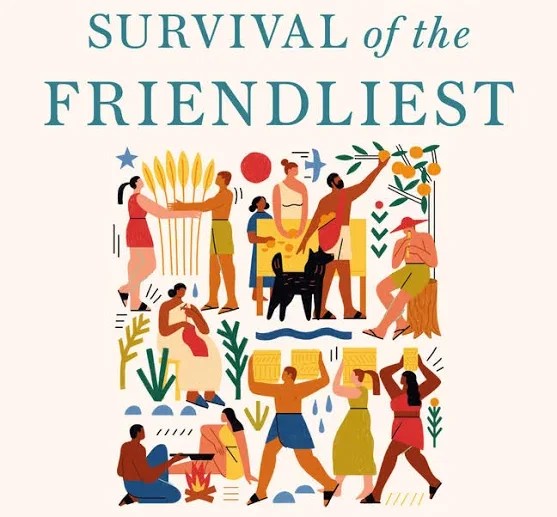
Central Thesis
The book challenges the conventional interpretation of “survival of the fittest.” Human evolutionary success did not come primarily from being stronger, more aggressive, or more ruthless than other species.
Instead, one of our greatest evolutionary advantages was friendliness: our exceptional capacity for social tolerance, cooperation, communication, and understanding other minds.
The central evolutionary chain can be summarized as:
friendliness / social tolerance
→ cooperative communication
→ larger and better-coordinated groups
→ sharing knowledge and innovations
→ more sophisticated culture and technology
→ human evolutionary success
But this same adaptation contains a paradox:
friendliness toward “us” can intensify hostility toward “them.”
The mechanisms that allow humans to form extraordinarily strong social bonds can also facilitate prejudice, dehumanization, and cruelty toward perceived outsiders.
Introduction — Friendliness as a Cognitive Superpower
The Jigsaw Classroom
During school desegregation in Austin in 1971, minority children such as Carlos entered classrooms where they could be mocked and marginalized. The conventional classroom structure could worsen the problem because students competed for the teacher’s approval; one student’s success could feel like another student’s loss.
The jigsaw method changed the social structure of learning.
Each student learned one part of a topic, and the students then had to combine their pieces to understand the whole. Success therefore required interdependence and cooperation rather than competition.
The important insight is that reducing hostility does not necessarily begin by persuading people to feel differently. Changing the structure of interaction can create cooperation, which in turn changes relationships.
Central idea
Friendliness, cooperation, and kindness should therefore be understood not simply as moral virtues but as cognitive and evolutionary capacities.
Humans survived and flourished partly because we became exceptionally good at working with other humans.
Chapter 1 — Thinking About Thinking
Theory of Mind
Theory of mind is the ability to understand that other individuals have their own:
- perceptions
- knowledge and memories
- emotions
- beliefs
- goals
- intentions
This ability makes sophisticated cooperation and communication possible because we can reason about what another person is trying to do.
But understanding another mind alone is not enough. The crucial human ability is using that understanding cooperatively.
Chimpanzees
Chimpanzees possess significant theory-of-mind abilities. They can understand what others have seen, know, remember, want, or intend.
However, their ability to use this information depends heavily on social context. They are particularly adept at reasoning about intentions in competitive situations, but are less flexible in using these abilities for cooperative communication.
Dogs
Dogs were historically regarded as cognitively unimpressive compared with apes. Yet experiments reveal a striking social intelligence.
For example:
- A dog can locate hidden food by following a person’s physical movement.
- If a human merely points toward the food, the dog can use the gesture successfully.
- Dogs can often follow novel gestures, suggesting that they are not simply responding to a memorized signal—they are sensitive to the communicative intention behind the gesture.
- Even dogs with relatively little intensive human training can show these abilities.
The important distinction is therefore:
general intelligence ≠ cooperative social intelligence
Dogs became exceptionally skilled at communicating with humans because their evolutionary history favored sociability.
Chapters 2–3 — The Power of Friendliness/Our Long-Lost Cousins
Cooperative Communication and Sociability
The dog experiments suggest an important connection:
sociability ↔ cooperative communication
The capacity for cooperative communication is therefore not uniquely human. Under the right evolutionary pressures, another species can acquire similar social-cognitive abilities.
This leads to the book’s major idea: domestication can change cognition.
Belyaev’s Fox Experiment
Dmitry Belyaev’s famous fox experiment selected foxes primarily according to how they reacted to humans.
Generation after generation, the friendliest foxes were allowed to reproduce.
Remarkably, selecting for friendliness did not merely make the foxes less aggressive. Over generations, other characteristics appeared as well:
- reduced reactive aggression
- increased attraction to humans
- floppy ears
- changes in coat color
- other physical and physiological changes
- enhanced ability to respond to human social gestures
So selection on one social trait—friendliness—produced a cluster of behavioral, physical, and cognitive changes.
This collection of changes is associated with domestication syndrome.
Dogs: Domestication Through Attraction Rather Than Fear
The traditional picture is that humans deliberately captured wolves and gradually transformed them into dogs.
The book emphasizes a different possibility:
The friendliest wolves effectively domesticated themselves.
Wolves that were less fearful of humans could approach human settlements and exploit a new ecological niche. Individuals attracted to humans gained access to resources unavailable to more fearful or aggressive wolves.
Over generations:
reduced fear of humans
→ greater proximity to humans
→ selection for friendliness
→ enhanced social communication with humans
→ domesticated dogs
Friendliness itself became a powerful selection pressure.
Bonobos vs. Chimpanzees — A Natural Experiment in Friendliness
The contrast between chimpanzees and bonobos provides another clue about how social tolerance can reshape cognition and society.
| Chimpanzees | Bonobos |
|---|---|
| Strong male hierarchy | No comparable alpha-male dominance |
| Males can be highly violent | Female coalitions constrain male aggression |
| Infants can become victims of violence | Infants occupy a more protected social position |
| Sexual coercion of females occurs | Female alliances reduce male coercion |
| Cooperation often exists within dominance and competition | High social tolerance, cooperation and sharing |
Bonobos rely heavily on social relationships, including relationships mediated through mothers, and show unusually high tolerance toward members of their own species.
The larger point is not simply that bonobos are nicer than chimpanzees. Their different social environments produce different opportunities for cognition and cooperation.
When aggression becomes less dominant, individuals can tolerate proximity, share resources, communicate, and cooperate more freely.
This provides a model for thinking about human evolution.
Chapters 4–5 — Domesticated Minds / Forever Young
The Human Self-Domestication Hypothesis
Humans may have undergone a process analogous to domestication—but without another species domesticating us.
The human self-domestication hypothesis proposes that human evolution increasingly selected against reactive aggression and favored greater social tolerance.
A simplified version of the process is:
reduced reactive aggression
→ greater tolerance
→ friendliness
→ more opportunities for cooperation
→ better cooperative communication
→ larger social networks
→ cumulative culture and technological innovation
This may help explain the dramatic acceleration of human cultural and technological development tens of thousands of years ago.
Domestication Syndrome in Humans
Traits associated with domestication can include physical, behavioral, and developmental changes.
Possible human parallels include:
Physical changes: reduced brow ridges, smaller jaws, shorter/more juvenile facial structure, increased visible white sclera facilitating eye contact, and other more gracile or juvenile features.
Behavioral changes: less reactive aggression, greater tolerance, greater cooperation and social flexibility.
Cognitive changes: stronger cooperative communication, greater sensitivity to other minds, and an enhanced capacity to coordinate within increasingly large groups.
Research discussed in this context also connects neural crest cell development with some of the physical and physiological traits associated with domestication syndrome.
Humans as “Forever Young”
Human development is unusually prolonged.
Human babies are born physically helpless, with weak muscles and incompletely developed skulls and brains. Their survival therefore depends intensely on caregivers.
This creates an evolutionary advantage for early-developing social cognition:
physical helplessness
→ dependence on caregivers
→ early sensitivity to social signals
→ ability to elicit and coordinate care
At the same time, human self-control develops extraordinarily slowly, extending into early adulthood as brain development and synaptic pruning continue.
Humans therefore retain unusually juvenile characteristics for a long period—both physically and socially.
A prolonged developmental window allows extraordinary amounts of social learning.
From Friendliness to Human Civilization
Human social organization also changed the role of aggression.
Among egalitarian hunter-gatherers, coalitions could prevent highly aggressive individuals from monopolizing power. Aggression could therefore be used collectively against domination, rather than primarily as a tool for establishing dominance.
Successful hunters, for example, could not simply take a proportionally larger share of resources. Sharing created reciprocal benefits: expertise in one domain could be exchanged for help in others.
This encouraged:
self-control + social tolerance
→ reciprocity and cooperation
→ group identity
→ larger networks of unrelated individuals
Humans became capable of recognizing abstract social identities and coordinating with people far beyond immediate kin.
This dramatically increased the scale of human societies and accelerated cultural and technological evolution.
Homo sapiens and Cooperative Communication
Homo erectus, Neanderthals, and Homo sapiens shared many important abilities. The book’s argument is that the decisive advantage of Homo sapiens was not simply greater individual intelligence.
Instead, cooperative communication allowed intelligence to become collective.
Once humans could coordinate effectively:
individual discoveries
→ communication
→ shared knowledge
→ preservation across generations
→ cumulative culture
Larger, better-coordinated groups could outperform other groups and continually accumulate innovations.
Humanity’s great evolutionary advantage was therefore not merely the individual brain, but the network of communicating brains.
Chapters 6–7 — Not Quite Human / The Uncanny Valley
Here the argument takes an important turn.
The very mechanism that made humans extraordinarily friendly also created the possibility of extraordinary cruelty.
The Paradox of Oxytocin
Oxytocin is strongly involved in social bonding. It can strengthen trust and attachment.
But bonding has a dual effect:
stronger “us” → potentially sharper distinction from “them.”
Under perceived threat, mechanisms associated with social bonding can contribute to stronger in-group bias and defensive responses toward outsiders.
So friendliness is not equivalent to universal benevolence.
It evolved largely as a mechanism for social bonding, and bonding necessarily raises the question:
Who belongs to the group?
Dehumanization
When outsiders are perceived as threatening, humans can stop applying ordinary social cognition to them.
The authors distinguish this from simple prejudice.
Prejudice = negative attitudes or feelings toward another group.
Dehumanization goes further: the other person’s mind, emotions, individuality, and human qualities are represented less fully.
The book connects this to theory-of-mind networks: the cognitive machinery normally used to understand another person’s inner life becomes less engaged.
This possibility appears across human populations; the crucial variable is not a particular ethnicity but who has been categorized as the threatening out-group.
The Uncanny Valley
The uncanny valley describes a peculiar emotional response to something that becomes increasingly human-like.
Initially:
more human-like → greater familiarity/comfort
But when something becomes almost human while still noticeably “off,” emotional comfort suddenly drops.
The result can be:
- unease
- eeriness
- fear
- revulsion
Once it becomes convincingly human again, comfort rises.
The book connects this psychological phenomenon with the human tendency to place beings—and sometimes other people—on implicit hierarchies of humanness.
Historically, ideas such as evolutionary ladders, “civilization scales,” and eugenics transformed differences between groups into supposed differences in human worth.
Thus:
categorization
→ hierarchy of humanness
→ dehumanization
→ reduced moral restraint toward outsiders
Dehumanization becomes one mechanism capable of explaining otherwise shocking human cruelty.
The Central Paradox of Self-Domestication
This is perhaps the most important conceptual turn in the book:
Human self-domestication explains both
our extraordinary friendliness
and
our extraordinary potential for cruelty.
The apparent contradiction disappears once friendliness is understood as group-oriented sociality rather than indiscriminate kindness.
Toward members of “us”:
friendliness → empathy → cooperation → protection
Toward threatening “them”:
group bonding → perceived threat → dehumanization → potential aggression
The two behaviors can therefore emerge from interconnected social mechanisms.
Why Ordinary People Can Do Terrible Things
The book then moves from evolutionary biology toward social psychology.
Three mechanisms are particularly important:
Prejudice — social categories create inequality and biased treatment.
Conformity — individuals often align their judgments and behavior with the majority.
Obedience to authority — people can perform actions they might otherwise reject when legitimate-seeming authorities instruct them to do so.
The implication is uncomfortable: cruelty does not necessarily require unusually cruel individuals.
Ordinary social cognition, operating under certain group structures and perceived threats, can produce extraordinary behavior.
Chapters 8–9 — The Highest Freedom / Circle of Friends
The final chapters ask what social arrangements can counteract the darker side of friendliness.
From Egalitarian Groups to Large Societies
Early hunter-gatherer societies often contained mechanisms that prevented individuals from monopolizing power.
With agriculture and increasingly large societies, hierarchical systems became easier to establish and preserve. Groups could fight other groups, accumulate resources, and monopolize political power.
Constitutional democracies represent an attempt to retain hierarchy while simultaneously creating institutional checks on concentrated power and protecting individual rights and egalitarian principles.
The broader question is therefore:
How can large societies preserve the cooperative advantages of human sociality without allowing hierarchy and group identity to produce domination and dehumanization?
Group Hierarchy and Authoritarianism
The book discusses psychological constructs such as:
Social Dominance Orientation (SDO) — preference for hierarchy between social groups, including beliefs that some groups should dominate others.
Right-Wing Authoritarianism (RWA) — a cluster of attitudes involving submission to established authority, conventionalism, and hostility toward groups perceived as threatening established social norms.
The larger theme is not simply political ideology. It is the relationship between:
perceived threat + group identity + hierarchy + conformity
and the human capacity to dehumanize outsiders.
Contact as an Antidote to Dehumanization
One of the book’s most important practical conclusions returns us to the jigsaw classroom from the introduction.
Information and education about intolerance can help, but abstract instruction alone has limited power.
Meaningful interpersonal contact is especially powerful because it changes the psychological category of the outsider.
The process is roughly:
contact
→ reduced perception of threat
→ recognition of another person’s mind and individuality
→ reciprocal humanization
Friendship therefore matters because it makes an abstract “them” into a concrete person.
This closes the circle begun with the jigsaw classroom: cooperation creates the conditions in which people can perceive one another as individuals rather than threatening categories.
The Book’s Argument in One Map
The entire book can be reduced to two interconnected evolutionary pathways:
The constructive pathway
selection for friendliness
→ reduced reactive aggression
→ social tolerance
→ cooperative communication
→ theory of mind used cooperatively
→ larger social networks
→ knowledge sharing
→ cumulative culture
→ technological innovation
→ human evolutionary success
The dangerous pathway
friendliness
→ stronger social bonds
→ group identity
→ “us” vs. “them”
→ perceived out-group threat
→ reduced mentalizing / dehumanization
→ conformity & obedience can amplify it
→ human cruelty
And the proposed counterforce is:
meaningful contact + cooperation
→ reduced threat
→ recognition of individuality
→ reciprocal humanization
→ expanded circle of friendship
Final Takeaway
The title Survival of the Friendliest is therefore more subtle than “kind people win.”
The book’s deeper argument is that friendliness changed the architecture of human intelligence. It allowed humans to coordinate minds, transmit knowledge, create enormous social networks, and build cumulative culture. Our species became powerful because we could make strangers into collaborators.
Yet that same ability depends on extraordinarily powerful social categorization. The mind that can recognize “one of us” can also construct “one of them.” Human kindness and human cruelty are therefore not necessarily opposite evolutionary tendencies; they can be two outcomes of the same intensely social psychology.
The final message returns to the evolutionary advantage with which the book began: our survival has depended less on how many enemies we can defeat than on how many others we can turn into friends.


